
Fly Fishing Guides in Italy
Guided Fly Fishing Trips in the Italian Alps
Guides, lodges, and fly fishing trips in Italy. A luxurious fly fishing operation specializing in the Italian Alps.
Dolomites Fly Fishing invites you to unwind and immerse yourself in the natural beauty and rich fishing traditions of Italy, with expert guides and a personalized schedule designed exclusively for you through our custom fly fishing itinerary service.
Explore stunning mountain landscapes, including the pristine rivers and lakes of the Dolomites from Trento, the majestic waters of the Central Alps near Lake Como, and the tranquil streams of the Orobie Alps from Bergamo.
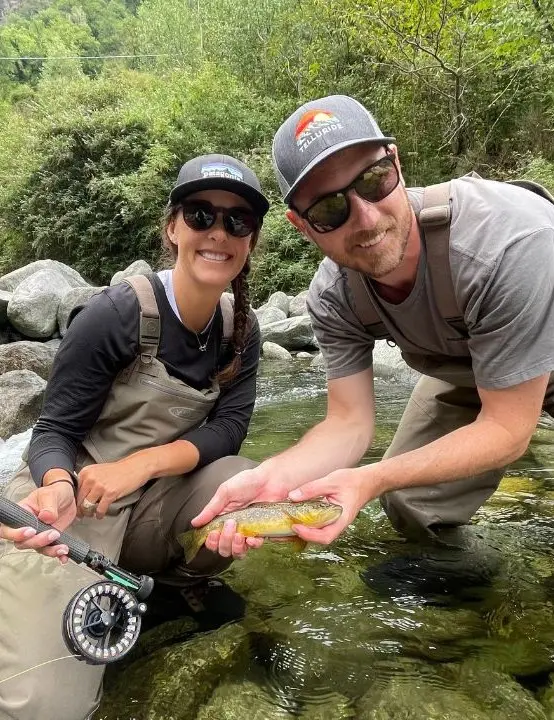
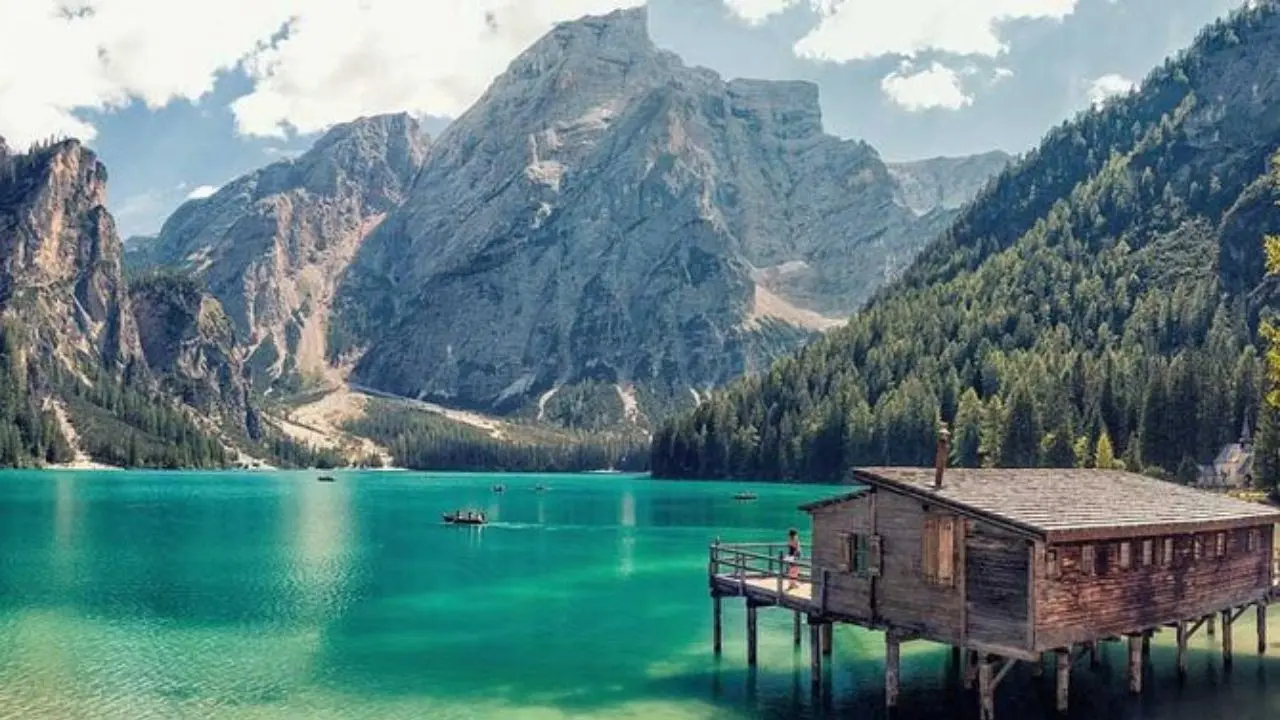
Fly Fishing Guides in Italy
Fly Fishing Guide Company in Italy
Would you like to enjoy a guided fly fishing trip in Italy?
If you’re here, it’s because you’re looking to have an unforgettable experience and enjoy fly fishing in the most beautiful mountains of Italy, the Dolomites.
Dolomites Fly Fishing is a small fly fishing guide company in Italy, backed by the legal coverage of the travel agency Viajes Pesca Mosca SL, and featuring the best guide team in Italy: Gianluca Ottavio and Aitor.
Additionally, for non-fishing companions, we offer parallel activities designed to let everyone experience authentic Italy through our private cultural, culinary, and nature tours.
Choose Dolomites Fly Fishing: we will create a trip that combines fishing with elegance, romance, and unforgettable experiences. Your adventure in Italy awaits!
Gianluca Bonomi
Fly Fishing Guide
Ottavio Tremolada
Fly Fishing Guide

Maria Rossi
Tourism Assistant - Guide
3 unique reasons to choose us over others
Tourist Experiences for Companions
The Best Private Waters
Luxury Hotels
About Us:
- Unlike other companies, we focus on both the anglers and their companions.
- We offer exclusive Fly Fishing trips in the Italian Alps, with all land services included from the moment you arrive at the airport.
- We are a group of local guides passionate about fishing and nature, and we will take you to the best rivers in the region while sharing our culture and traditions.
- We work with the best accommodations and provide professional, personalized service. Additionally, we are a legal company with civil liability and accident insurance, and we also operate as a travel agency.
- We know every corner of the Italian Alps perfectly, ensuring you have a unique experience!
Fly Fishing in Italy: All You Need to Know.
FREQUENTLY ASKED QUESTIONS
Best Places for Fly Fishing in Italy
1 - Regorie Reserve (R1) of the Upper Sarca (Trentino Alto Adige)
Season: Open from the last Saturday of February to October 31st.
Setting: Medium-sized river with a valley bottom streambed. Alternating currents with slow pools.
Species: Marble trout, brown trout, and rainbow trout.
Trout size: Possibility of large trophy fish.
Fishing type: Dry fly, nymph, and streamer, with a maximum of 2 flies per line and barbless hooks. The use of a landing net is mandatory.
Permit price: 50 euros.
PROS
- One of the best places in Italy for catching trophy trout.
- Presence of marble trout, highly coveted by foreign anglers.
- The fishing area covers a length of 1.5 kilometers, with a maximum of 4 anglers allowed per day.
- Good car access to the fishing zone.
cons
- Highly sought-after fishing location with very limited availability.
- It is recommended to hire a fishing guide company to obtain a fishing permit.
- Daily fishing cost is higher compared to other locations.
2 - Reserves R2, R3, and R4 of the Upper Sarca (Trentino Alto Adige)
Our hotel Villa Madruzzo, located in the charming town of Trento, offers privileged access to four stunning fishing reserves, considered among the best fly fishing spots in Italy. All of these reserves practice catch-and-release fishing and are expertly managed by the Alto Sarca Fishermen’s Association. This association actively works to enhance the natural productivity of these waters by releasing fry and adult specimens and maintaining and reinforcing the original genetic lines.
Each reserve has its extent and daily angler capacity. To obtain a fishing permit, one must be a member of the fishing society or have an invitation from clubs like our fishing guide company, which has the privilege of guiding in these waters upon pfiumer reservation. Among the most notable reserves are:
- R2 – Arnò: The «R2» reserve is located in the upper part of the Arno River, one of the main tributaries of the Sarca River, offering a 1.1 km stretch of stream abundantly populated with medium-sized brown trout. It has limited access for a maximum of 3 anglers per day.
- R3 – Fiume Vallesinella: The «R3 Vallesinella» reserve allows only 2 anglers per day. It is located in the upper Val Rendena. This is a 900-meter mountain river stretch located at the base of the Brenta Dolomites. In this location, you can catch Marble Trout, Marble Hybrid Trout, and many Brown Trout.
- R4 – Maroc del Ghiro: This is a 700-meter river stretch with a daily capacity of 2 anglers. It is located near Porte di Rendena. It is the perfect place for Marble Trout fishing. In addition to this species, you can also find Brown Trout, Marble Trout Hybrids, and some Rainbow Trout.
Season:
- R2 – Arnò from 24/02/2024 to 30/09/2024
- R3 – Fiume Vallesinella from 20/04/2024 to 30/09/2024
- R4 – Maroc del Ghiro from 24/02/2024 to 31/10/2024
Setting: Medium-sized river with a valley bottom streambed.
Species: Marble trout, brown trout, and rainbow trout. Depending on the scenafiume.
Trout size: Depending on the scenafiume.
Fishing type: Dry fly, nymph, and streamer, with a maximum of 2 flies per line and barbless hooks. The use of a landing net is mandatory.
Permit price: 35 euros.
PROS
- Abundance of trout in all scenafiumes.
- Some of these reserves have marble trout, highly coveted by foreign anglers.
- Possibility to fish the reserve and other waters managed by the Association.
- Limited daily quota of people.
cons
- Highly sought-after fishing location with very limited availability.
- It is recommended to hire a fishing guide company to obtain a fishing permit.
- Daily fishing cost is higher compared to other locations.
3 - Val di Fumo (Trentino Alto Adige)
Val di Fumo is an alpine valley located in the Adamello-Brenta National Park in Italy, renowned for its natural beauty and mountain trails that attract hikers and nature lovers from around the world. In this scenafiume of incredible beauty, possibly one of the most beautiful in Europe along with some places in the Spanish Pyrenees, it is possible to fish for brown trout and Brook Trout. All of this is set in a dreamlike environment at the foot of the Adamello glacier.
The location is a catch-and-release stretch of about 6 kilometers managed by the Alto Chiese Fishermen’s Association. To access this area, a 5-kilometer hike is required, so it is recommended to fish with quick-drying pants and without waders.
This is one of the scenafiumes we offer on the long-duration trips from our hotel Villa Madruzzo in the town of Trento.
Season: End of May to September 30th.
Setting: River in a beautiful glacial valley.
Species: Brown trout and brook trout.
Trout size: Small to medium.
Fishing type: Dry fly and dropper nymph – dry. Maximum 2 flies and no barb.
Permit price: 20 euros.
PROS
- It is a place of incredible beauty.
- There is a good population of trout and brook trout.
- Fishing is generally done with dry flies. Terrestrial insects work very well.
cons
- Good physical condition is required to access this location.
- Guided fishing days are slightly shorter, as it is necessary to walk to access the fishing area.
- It is not a place to fish for large trout.
4 - Torrente Rabbies - Val di Sol (Trentino Alto Adige)
Val di Sole is located just over an hour from our hotel in Trento, in the Trentino-Alto Adige region. This alpine valley lies between the Adamello Brenta and Stelvio Natural Parks. The waters of this beautiful valley, through which the Rabbies stream flows, are managed by the Sonaldri Fishermen’s Association.
The valley features a tourist catch-and-release fishing reserve called «Le Marinolde» (RNK1). Notably, this reserve is 2.5 kilometers long, issues only two daily fishing permits, and its lower part was closed to fishing from 1986 to 2015.
Tourists can fish in this area with a license and by purchasing a fishing permit. Those holding a permit for this reserve can fish the same day in all other concession waters using the same methods and the same permit.
Season: From the first Sunday in March, typically lasting until September 30, and in some exceptions, until October 30.
Setting: Mountain stream.
Species: Marble trout and brown trout.
Trout size: Medium.
Fishing type: Dry fly, nymph, and streamer with barbless hooks and a maximum of two flies.
Permit price: 38 euros for the «Le Marinolde» (RNK1) reserve, and 20 euros for the rest of the waters.
PROS
- High quantity of trout.
- Beautiful scenery.
- Fun river to fish with a dry fly.
- Possibility to catch marble trout.
- Good car access to the fishing area.
cons
- Not a trophy trout setting.
5 - Fiume Aurino (Trentino Alto Adige)
The Aurino stream, known as Ahr in German, originates from the «Vette d’Italia» and runs through the Aurina Valley until it joins the Rienza River in the town of Brunico, in the heart of the Dolomites Alps. Fishing in this river is privately managed, with permits ranging between 80 and 100 euros per day. This higher cost ensures good-sized catches and low fishing pressure.
Considered Italy’s premier river for grayling fishing, it also offers the possibility of catching beautiful marble trout up to 50 cm long. It is a technical river, with spring and autumn being the optimal months for fishing.
Season: March 1 to November 30.
Setting: Glacial mountain river.
Species: Marble trout and grayling.
Trout size: 30-50 cm.
Fishing type: Nymph and dry fly.
Permit price: 100 euros per day.
PROS
- Low fishing pressure.
- Beautiful scenery.
- Abundance of good-sized fish.
- Vehicle accessibility.
- Italy's top destination for grayling fishing.
cons
- High permit costs.
- Fishing affected by glacial runoff.
- Not always conducive to dry fly fishing.
6 - Valtellina y Valchiavenna (Provincia de Sondrio)
Valchiavenna, along with Valtellina, is one of the two main valleys that make up the province of Sondfiume. This charming province is located in northern Italy. Valtellina stretches along the Adda River valley, and Valchiavenna along the Mera River, surrounded by the majestic peaks of the Rhaetian Alps. Its alpine landscapes encompass a unique culinary and cultural experience, with terraced vineyards, medieval villages like Tirano, and culinary specialties such as bresaola and the famous Nebbiolo wine.
The rivers in this region are managed by the Sport Fishing Union of the Province of Sondfiume. This fishing area is conveniently located near and easily accessible from Milan, the Italian fashion capital.
Season: It starts on the last Sunday of February in Prestone, Isola, and Madesimo, while in Val di Lei and Livigno it begins on May 1. Grayling fishing is possible starting May 12. Fishing in certain locations continues until November.
Setting: Highly diverse. Includes mountain streams, lakes, and valley-bottom rivers.
Species: Brown trout, rainbow trout, marble trout, and grayling.
Trout size: Medium-sized.
Fishing type: Dry fly, nymph, and streamer with barbless hooks.
Permit price: 25 to 45 euros.
PROS
- Wide variety of fishing locations.
- Great destination for marble trout and grayling fishing.
- Permits are reasonably priced.
cons
- Limited information available about the destination.
7 - Fiume Sesia, Piode Reserve
This stretch of river spans 7 kilometers within the municipality of Piode, along the Fiume Sesia. The river scene extends from the center of Campertogno to the village of Pila, renowned as one of Italy’s premier fishing reserves. Management of this section of the river is overseen by the Valsesiana Pescatori Sportivi Society.
Fishing is strictly catch-and-release using fly fishing techniques, with the allowance to keep only one large trout per day. The maximum number of anglers per day is limited to 6.
Species found in this section of the river include marble trout, grayling from the Po Valley, as well as brown and rainbow trout.
Season: Wednesdays, Fridays, Saturdays, Sundays, and holidays from Saturday, April 24th, until Sunday, October 3rd, plus May 1st and June 2nd.
River Scene: A clear-water, mountain stream featuring alternating currents and pools.
Species: Brown trout, rainbow trout, marble trout, and grayling.
Trout Size: Between 30 and 50 cm.
Fishing Techniques: Dry fly, nymph, and streamer fishing with barbless hooks.
Permit Price: 100 euros per diafiume (fishing day).
PROS
- Excellent for catching large trout.
- Home to marble trout, highly sought after by international anglers.
- Covers a 7-kilometer stretch with a maximum of 6 anglers per fishing day.
- Good car access to fishing zones.
cons
- High demand makes availability limited.
- Hiring a fishing guide service is recommended to secure fishing permits.
- Fishing costs are higher compared to other locations.
8 - Valsesia-Mastallone
Valsesia is located in the Piedmont region of northern Italy, near the border with Switzerland. The earliest known document regulating fishing in Valsesia dates back to 1478. These medieval manuscripts already mention «Valsesian-style» fishing, similar to the «Leonesa» style practiced in Spain.
The main river is the Fiume Sesia, originating from glaciers on the southeast side of Monte Rosa. The waters of this region, including those of the Mastallone basin, are managed by the Società Valsesiana Pescatori Sportivi.
The primary tourist fishing reserve is in Varallo, where brown, rainbow, marble, and hybrid trout can be caught. Other tourist attractions include the Scopello reserve; the «Alta Valle Sesia» tourist stretch; «La Selva» reserve; «Landwasser» reserve; Piode – Fiume Sesia reserve; Egua stream; and Sermenza stream.
Season: Varies by section, generally from February 25th to the end of October.
Scenarios: Varied, including mountain rivers, valley floors, and lakes.
Species: Brown, marble, and rainbow trout.
Trout size: Medium.
Fishing techniques: Dry fly, nymph, and streamer with barbless hooks.
Permit price: Permit prices range from 35 to 52 euros.
PROS
- Abundance of trout.
- The region experiences clearer water flows even during thawing in months like July.
- Variety of fish species.
- Reasonable permit prices.
cons
- It is somewhat remote from major tourist cities, with Milan being the closest.
Why Fly Fishing in Italy?
- Marble Trout: Salmo marmoratus, is a variety of brown trout that lives in some rivers in Italy whose basin belongs to the Adriatic Sea. It is highly coveted by fishermen from all over the world.
- Trophy Fish Fishing: In Italy, you can catch large marble trout, rainbow trout, and brown trout in the river reserves of the valley bottoms.
- Private Waters: Private management of certain river stretches ensures a large number of catches, some of which are of considerable size and without high fishing pressure.
- Incredible Natural Landscapes: Our trips focus on the Italian Alps, more specifically in the Dolomites, surrounded by incredible National Parks.
- Destination for Fishermen and Companions: Italy is a destination where fishing can be combined with art, history, gastronomy... ideal for traveling with companions who do not fish.
- Food and Wine: In addition to fishing, you will enjoy Italy's excellent cuisine accompanied by great wines such as Chianti, Barolo, and Prosecco.
Trout Species for Fly Fishing
- Salmo trutta (Brown Trout) : Atlantic and Danubian distribution.
- Salmo marmoratus (Marble Trout) : Found in the Po Valley, Croatia, and Slovenia.
- Salmo cettii (Sardinian Trout or Sarda Trout, formerly macrostigma) : Distributed in Sardinia and Sicily, lakes Posta Fibreno and Ninfa, and some Tyrrhenian watercourses.
- Salmo ghigii (Apennine Trout or Adriatic Trout) : Found in the Adriatic and Tyrrhenian Apennine basins.
- Salmo fibreni (Fibreno Carpione) : Found in the Posta Fibreno Lake.
- Salmo carpio (Garda Carpione) : Found in Lake Garda.
- Salvelinus alpinus (Arctic Char) : Found in cold regions of the northern hemisphere. In Italy, it is relictually present in the Alpine region of Trentino-Alto Adige and has been introduced into various Alpine and Prealpine basins.
- Thymallus thymallus thymallus (European Grayling) : One of the five grayling species worldwide, inhabiting Europe and Italy.
Fishing Licenses and Permits
- Governmental License for Sea Fishing: Requires registration with the Ministry of Agricultural, Food and Forestry Policies to obtain a free license downloadable via mobile or PC.
- Governmental License for Inland Waters (managed by each region):
- Type B - Amateur License: Valid for one year with costs ranging from 20 to 40 euros, varying by region of residence. Payment is made to a specific bank account and must be accompanied by a valid ID.
- Type C - Temporary Amateur License: Valid for 15/30 days with lower costs compared to Type B. Requires specific payment according to the region and must be presented with valid ID.
- Type D License: Not available in all regions and its purpose varies. It may be daily or for foreign residents, with validity depending on the region.
Certain cases exempt individuals from needing a license, such as minors accompanied by licensed adults, minors with a fishing course certificate, individuals over 65 years old, persons with disabilities, foreigners in competitions, those engaged in paid fishing, and fishing in private spaces.
In addition to the fishing license, for fishing in rivers inhabited by trout, it is essential to possess a daily fishing permit specific to the corresponding area («permiso diafiume»). There are two types of waters:
- "Open waters" accessible to anyone with a valid fishing license who purchases a seasonal permit.
- "Tourist sections with special regulations," accessible to members of specific fishing associations and tourists who pay a daily fee after making a reservation.
The sale of fishing permits varies by region and river section, generally available online, in hotels, shops, and restaurants. In regions like Trentino, to promote fishing tourism, fishing without a governmental license is possible with a single daily fishing permit for a specific section, which combines the functions of a license and fishing permit.
For online purchases of fishing permits, there is a useful application called HOOKING that consolidates permits from various fishing associations’ reserves.
This system ensures that fly fishing enthusiasts can enjoy the sport responsibly while complying with Italy’s regulations governing recreational fishing.
Fly Fishing Season in Italy and Best Months
- Valle d'Aosta: Last Sunday of March. Exceptions include Regional Consortium Reserves (Marmore, Evancon, Ayasse, Urtier) starting on May 1st, and the tourist reserve of Lys (in Gressoney-La-Trinité) typically beginning the season on the first Saturday of June. Alpine lakes begin their season in mid-June.
- Piedmont, Lombardy, Liguria: Last Sunday of February.
- Sondrio: Third Sunday of March.
- La Spezia ("precious" waters) : Last Sunday of March.
- Trentino Alto Adige: From the first Sunday of February to the first Sunday of March (some sections start in January).
- Veneto: First Sunday of March.
- Friuli Venezia Giulia: Last Sunday of March.
- Tuscany, Marche, Umbria, Lazio, Abruzzo, Molise: Last Sunday of February (this year: February 23rd). Certain rivers like Fiume Nera, Borgo Cerreto, Ferentillo begin on April 1st, and the Tail Water Tevere starts on May 1st.
- Campania: Last Sunday of February; "ZRS 1" Zone of Fiume Sele (Province of Salerno): Last Sunday of March.
- Puglia: From January 15th.
- Basilicata: First Sunday of February.
- Calabria: Second Sunday of March.
- Sicily: From January 15th.
- Messina: February 15th.
- Caltanisetta: Last Sunday of February.
- Ragusa: February 28th.
- Siracusa: March 1st.
- Sardinia: Trout fishing starts on February 1st, rainbow trout on March 1st, and Macrostigma trout remains closed for the season.
Best Months for Fly Fishing in Italy
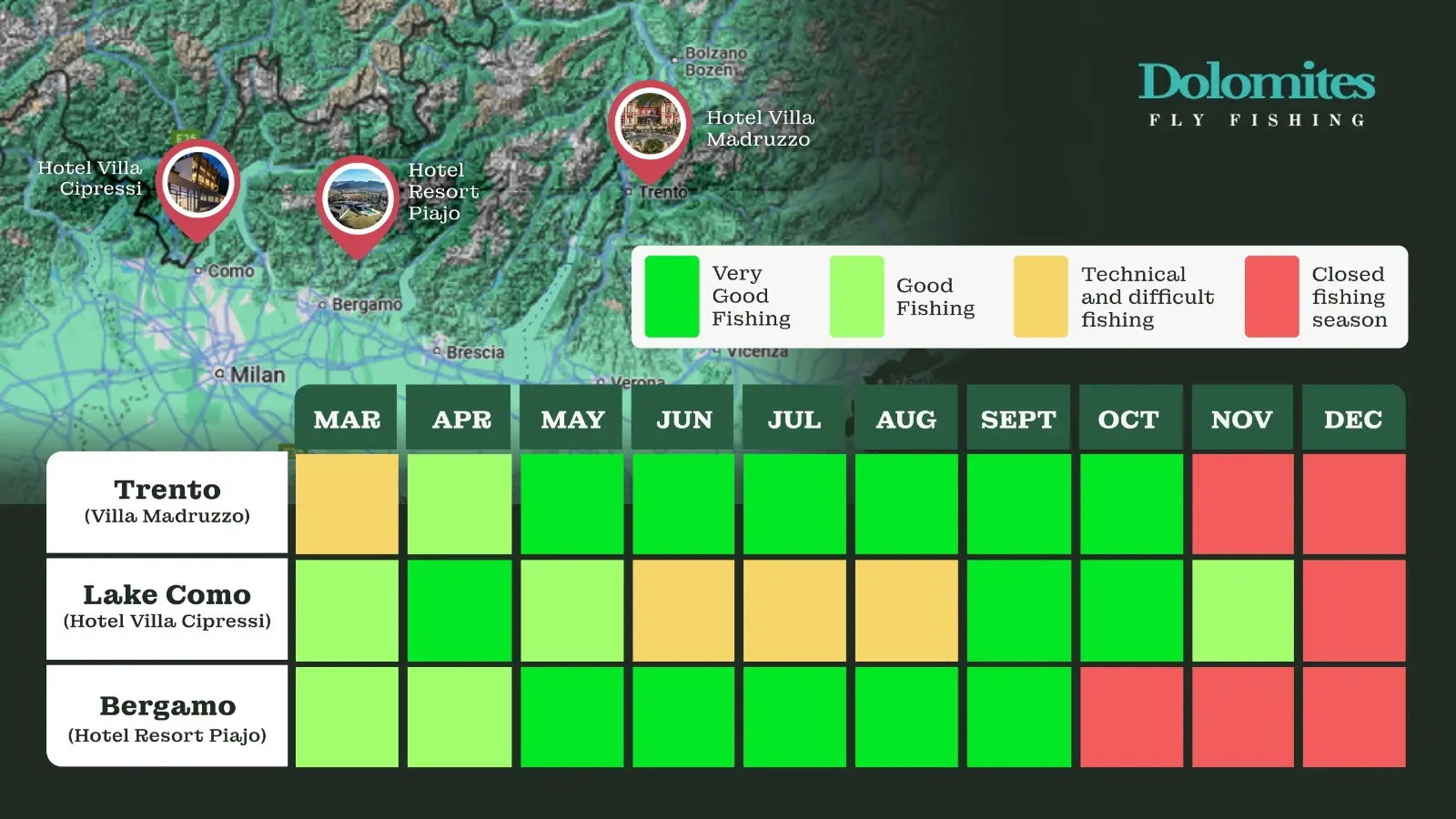
- During the early months of the season, wild trout tend to have limited activity. In contrast, rainbow trout are often more active during this initial period. It's advisable to target areas where trout have been artificially introduced early in the season. In Alpine glacial rivers, before the thaw begins, water flows are optimal for fishing. This period is favorable for catching large trout in gentle-flowing rivers during midday using dry flies. Mayfly (March Brown) hatches can be observed, and sometimes larger trout feed on the surface.
- May is a month to avoid fishing in snow-fed rivers located in the foothills of the Alps, the Apennines, and the Abruzzo region, as snowmelt increases water flow. It's a good month to fish in lower mountain systems like the Tuscan Apennines, Central Sicily (Nebrodi and Madonie mountains), or the Gennargentu mountains in Sardinia.
- Summer months are ideal for fishing, although caution is needed in the southern part of the country and certain main Alpine rivers originating from glaciers. In these majestic ranges with peaks over 15,000 feet and glaciers, water can become milky and flow may increase due to summer thawing in July and August. It's advisable to fish in tributary rivers during these months. Fishing during the cooler hours of the day, when major insect hatches occur and trout become more active, is recommended.
- Autumn is traditionally a prime time for fly fishing in Italy. During this season, trout intensify their feeding activity before the spawning period. Lower altitude mountain rivers receive more oxygen, water temperatures decrease, and trout activity increases. In glacial rivers, thawing concludes, and water clarity improves, making it ideal for fishing. November can be challenging in many rivers, especially in the Alps where fishing is permitted.
Insects & Hatchings
Fly fishing in Italy offers a unique experience, especially during the months and times of day when aquatic insect hatches occur.
During hatches, it’s essential to use imitations that closely match the size, color, and behavior of the present insects. Understanding the life cycles of insects such as mayflies, stoneflies, and caddisflies, and using the right flies, is crucial for a successful fly fishing experience in Italy. This is where the expertise of a fly fishing guide in Italy becomes invaluable.
Below, we discuss the most important insects during hatches and how they influence fishing in Italian rivers and lakes.
Key Insects During Hatches:
- Mayflies (Ephemeroptera) Mayflies (family Ephemeroptera) are likely the most well-known group of insects among fly anglers due to their massive hatches. Their name derives from their brief adult lifespan: after emerging, adults live only a few hours or days. In contrast, the larvae remain in the water for several months or even years before transforming into adults. Mayflies emerge throughout the year, but their presence is more prominent during cooler months in the middle of the day. In warmer months, they typically appear at dawn and dusk. However, the peak of mayfly hatches in Italian rivers occurs between April and July.
- Stoneflies (Plecoptera) Stoneflies (family Plecoptera) are a key aquatic insect for fly fishing in Italy. Their larval phase develops in cold, well-oxygenated waters, making them indicators of healthy aquatic ecosystems. Large stonefly hatches usually occur in spring, particularly in May and June. In contrast, smaller stoneflies, known as Capnia or commonly referred to as winter stoneflies, emerge during the late season and winter months.
- Caddisflies (Trichoptera) Caddisflies (family Trichoptera) represent another common group of aquatic insects in many Italian rivers. Their larvae are known for building small shelters from stones, twigs, and other materials collected from the riverbed. Adults primarily emerge in spring and summer, between June and mid-September. Massive caddisfly hatches occur on summer evenings, especially in granite-origin mountain streams.
- Other Insects In Italy’s mountain rivers, particularly those surrounded by alpine meadows, terrestrial insects like grasshoppers and beetles are very common. They are especially effective during midday hours in summer. On the other hand, chironomids or midges play a crucial role in lake fishing, especially at dawn and dusk.